
Key Takeaways / Summary:
- The technician locates and uncovers the tank access lid on your property.
- High-powered vacuum equipment removes scum, liquid, and accumulated sludge layers.
- Essential components like baffles and tank walls are inspected for proper flow and condition.
- The system is closed securely, leaving your yard neat and fully operational.
Knowing what happens during a septic tank pumping process helps remove the mystery and gives you total confidence in your home care. At Helton Ingram Septic, our goal is to deliver straightforward service with uncompromised quality for every family in Cleburne, Texas.
We take pride in running our company with complete professionalism, ensuring that your system gets treated with the highest standard of care from the moment we pull up to your driveway.
How the Technician Locates and Opens the Tank
When our truck arrives, the first step is finding the exact location of your underground tank. If you already know where the access lids sit, that speeds up the process, but our technicians are trained to trace line runs and identify subtle ground cues. Once identified, we carefully clear away topsoil or lawn cover to reach the access points.
Opening the lid requires proper tools and physical effort, as these concrete or heavy plastic lids must form a tight seal to protect your yard. Removing the main access lid gives us full visual access to both sides of the tank structure.
What Gets Removed and How
A healthy septic tank naturally separates household wastewater into three distinct layers: floating scum at the top, clear liquid in the middle, and heavy sludge settling on the bottom. Pumping is designed to clear all three components completely.
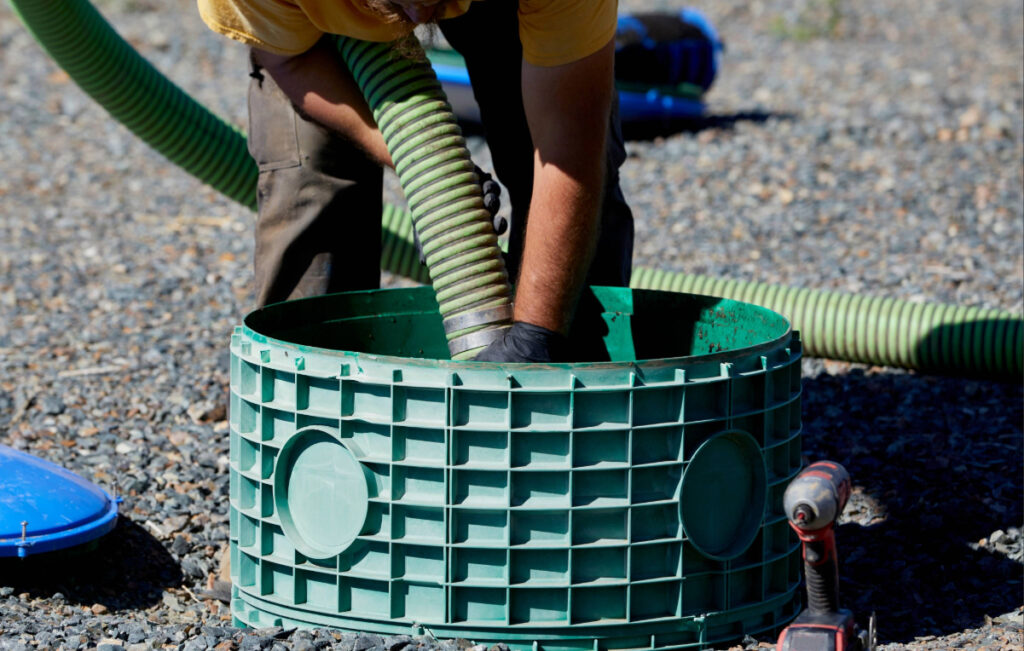
Our team lowers a large vacuum hose directly into the tank. We use specialized equipment to break up settled solids on the bottom so everything extracts smoothly. We never leave solid waste behind, as thorough cleaning prevents premature backup issues and protects your drain field.
What a Good Tech Checks While They Are There
Pumping the tank is only part of our services. Once the liquid levels drop, our technicians look inside to review the condition of the internal components.
- We examine the outlet baffle, which prevents solids from washing out into your absorption field.
- We check the inlet baffle to ensure wastewater flows freely into the tank without line blockages.
- We also inspect the overall structural condition of the tank walls, checking for cracking, root intrusion, or deterioration.
Spotting small issues early saves you from costly secondary repairs later.
How Long the Job Takes and What It Costs
A standard residential pumping service generally takes anywhere from 45-90 minutes, depending on the size of the tank and accessibility. Larger tanks or buried lids that require extensive digging can add a bit of extra time.
Furthermore, pricing typically depends on tank capacity, the volume of waste removed, and ground conditions. We prioritize fair, transparent pricing without hidden surprises, giving you full clarity before work begins.
Dedicated to Quality Service in Cleburne, Texas
Your home relies on a healthy, functional wastewater system, and your number two is our number one. We believe in getting the job done right the first time, holding ourselves to strict company standards so you always receive top-tier care.
If you are due for regular maintenance or need your system inspected, reach out to our team today!
Image Credit: Pamela Au / Shutterstock